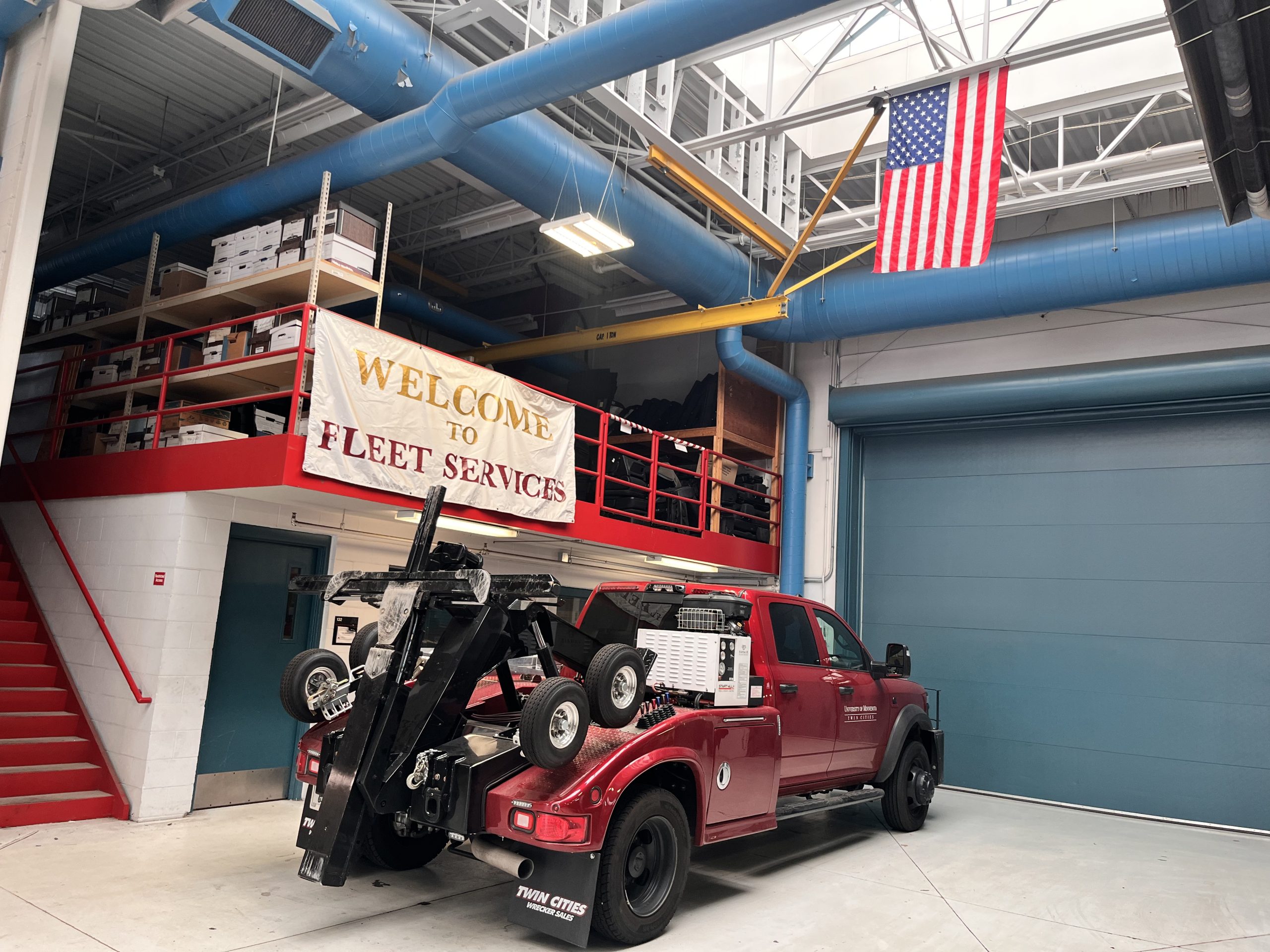

The fall semester at the University of Minnesota kicked off a few weeks ago and I was once again reminded of how the university is like a little city to itself. From my office window on the West Bank, I have the privilege of watching not just the deluge of students, but the constant preparations of the thousands of university workers who maintain the streets, shrubs and public spaces.
I want to confess one small fascination: the variety of vehicles that the university sends around campus. There seems to be no end to it, from golf carts to 60-foot buses. After years of prevarication, I finally reached out to ask about their fleet. Is it complicated? How do they pick vehicles?
Here’s what I learned.
The university has a lot of vehicles, including for their own police department, their own transit agency and even their own jurisdiction over some streets. There’s a lot going on and it is complicated.
“Nothing’s set in stone,” said Rob Spector, shop manager for Fleet Services. “We’re like a city, but more so in some ways, with stores and with waste and our own heating plants.”

Spector is a life-long car guy who has worked all over the university and has a mechanic’s eye for thinking about the hundreds of vehicles under his purview. For example, he personally designed the bespoke water trucks, made to allow student workers to water plants on-the-go around campus.
The bulk of vehicle maintenance is done through Fleet Service’s facility in Southeast Como. Though the exact number changes almost daily, they have around 900 vehicles leased or loaned to different departments, units and campuses.
There are all kinds of micro-jurisdictions determining who “owns” what. For example, both Facilities Management and Land Care have their own fleet vehicles and acquisition process. The former deploys all kinds of golf carts and the latter is responsible for Bobcat snow sweepers and the like.
Related: Metro Transit’s Green Line Extension will open in June. Its competitors are … excited?
Then there are the different departments with different needs. Geology, for example, has its own set of vehicles used for fieldwork trips and hauling rocks. There’s less call for these in the social sciences, as you might imagine, but any department can rent vehicles for various journeys. Meanwhile, the Fleet Services office has its own maintenance facility and car wash employing three full-time mechanics who work to keep the hundreds of vehicles in operating order.
Finally, there are the large vehicles. The university has 60 heavy trucks (over 26,000 pounds) including a wrecker tow truck, two rolloff trash trucks, four compactors, a mobile audiology lab truck, a mobile dentistry lab truck and a mobile ECMO truck (extracorporeal membrane oxygenation) – one of only four in the state.
The highest mileage vehicle in the fleet is a special freezer van used to collect donated organs (specifically, eyeballs) for Lion’s Gift of Sight, facilitating eye transplants since the 1960s.
The vehicles I most wanted to know about, however, were the Japanese mini-trucks. There’s been a quiet trend of small “Kei trucks” gaining ground in the U.S. and I was curious if the university was in on it. Spector explained that those were purchased by Facilities Management and they had about 30 of them – Suzuki and Daihatsu – in the overall fleet.
In Japan, the trucks can drive up to 70 miles per hour, but around campus they are speed-limited. From an outsider’s perspective, I presumed small-size vehicles would appeal to efficiency and scale, but everything comes with a catch.

“They have airbags, and the reliability is pretty good, but parts and service is really bad,” Spector admitted. “There’s one dealership in Michigan, so if you need glass – if a windshield breaks – you don’t just go to Safelite. We have to call the dealership and it’s shipped [from] overseas. It’s three months to get a piece of glass.”
The other big question on my mind was electrification. With the price of diesel hitting extreme levels, fueled by Trump’s ongoing war with Iran, institutions with electrified vehicle fleets should be feeling good about those decisions. Paying more up front for chargers and the like hurts the capital budget, but operations budgets look much better down the road, especially when diesel costs double.
It turns out that, for the most part, the university hasn’t yet made great strides in fleet electrification.
“Today, our stance is to reduce emissions any way possible,” said Melina Helgeson, Fleet Services’ assistant director. “And the most practical way is to veer towards hybrids and plug-in hybrids. [But] it’s a headache just because of the charging infrastructure, and we are working through those steps right now.”
Related: What should Minneapolis do about Waymo?
For now, though, the spike in the cost of diesel fuel hasn’t hit the university’s budget. The institution signs one-year contracts for fuel each February and has been paying about $2 per gallon all year long. When the new contract comes up, it’ll be a different story. Expect more belt tightening, like the huge cuts announced this week across the entire university.
As an outsider and policy wonk, institutional fleets have always seemed to me to offer a relatively simple opportunity to reshape a transportation system. The economics and logistics of institutional usage allow for change more quickly than within society at large. For example, Fleet Services buys more than 100 new vehicles every year, which means they could replace a large percentage of their total stock in a short period of time.
I would have hoped that by 2026, institutions and governments would have moved more quickly to adopt efficient, lower maintenance and less polluting technologies. With the high cost of diesel, it would have been nice if our governments and other major institutions had already done this hard work of decarbonizing our transportation system.
Instead, the institutional inertia of the U.S. automakers, which continue to make ever-larger fossil-fueled vehicles, has been exacerbated by the rollback of electrification subsidies at the federal level. It seems like change is hard for everyone, even if they’re centrally organized. It’s getting harder these days to dream of electric school buses.
The post Trash trucks, mini-trucks and an eyeball truck at the University of Minnesota, but few EVs appeared first on MinnPost.
Originally reported by MinnPost by Bill Lindeke. Read the full story at the source.
Comments
No comments yet. Be the first to share your thoughts.
Leave a Comment