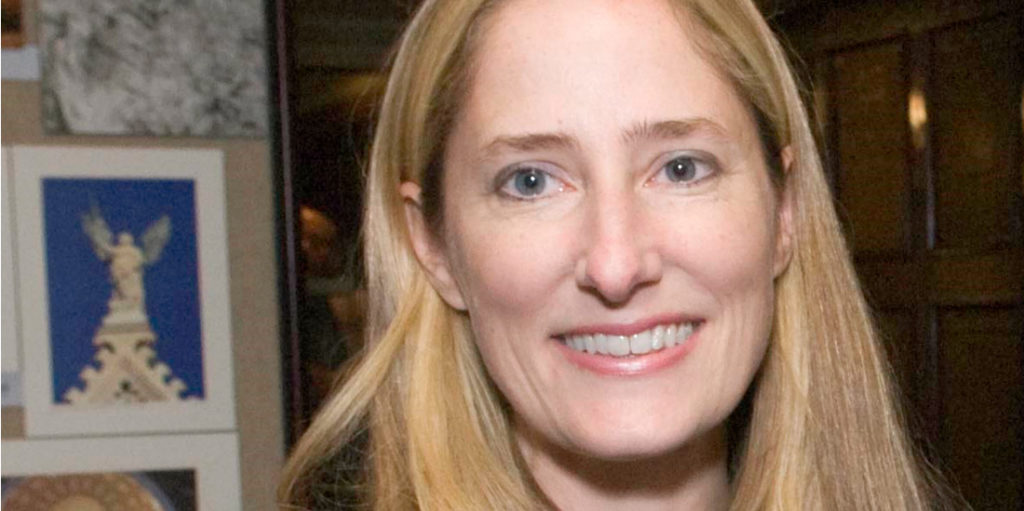
Janine Jackson interviewed the Institute for Policy Studies’ Sarah Anderson about the Letelier/Moffitt murders for the October 2, 2026, episode of CounterSpin. This is a lightly edited transcript.
Janine Jackson: On September 21, 1976, former Chilean diplomat Orlando Letelier, his colleagues at the Institute for Policy Studies Ronni Karpen Moffitt and her husband Michael Moffitt, were riding in Washington, DC, when a car bomb exploded, throwing Michael Moffitt from the car and killing Orlando Letelier and Ronni Moffitt. The horrific act, which Secretary of State George Schultz called, at the time, “perhaps the only clear case of state-supported terrorism that has occurred in Washington, DC,” was subsequently tied directly to Chilean dictator Augusto Pinochet.
The 50th anniversary of this event is reawakening memories of the attack for some people. Some are no doubt hearing about it for the first time, and some don’t need reminding, because the atrocity—its meanings and its impacts, the work it’s taken to unearth it—are very present-day concerns.
Sarah Anderson directs the Global Economy Project at the Institute for Policy Studies, and co-edits the site Inequality.org. She joins us now by phone. Welcome back to CounterSpin, Sarah Anderson.
Sarah Anderson: Good to be here. Thank you.
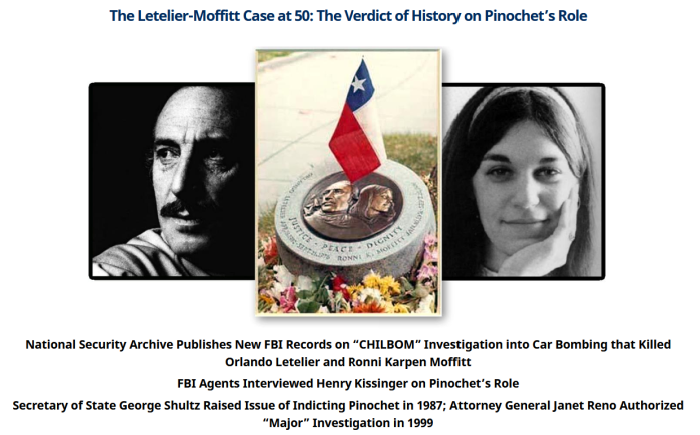
National Security Archive (9/21/26)
JJ: I want to be clear: We can’t do chapter and verse on this. I would refer folks to IPS’s work, of course, and that of the National Security Archive and Peter Kornbluh, for more details than we can give now. And the details are of course important. But I would ask you to take us back to September 1976 and the political climate of the time. What should we know about, for instance, US and Chile relations that can provide some context for what happened on that day?
SA: Absolutely. Well, this was the Cold War era, and the Nixon administration and President Nixon’s sidekick, Henry Kissinger, very much viewed Chile through that lens. The United States was competing against the other global superpower, the Soviet Union, for global dominance. And Chile had elected, in 1970, the world’s first democratically elected socialist candidate for president, Salvador Allende, and he ran on a campaign of helping to redistribute wealth in this very unequal country, and Nixon and Kissinger just viewed him as a threat, that he could start, like, a beachhead for the Soviets in Latin America.
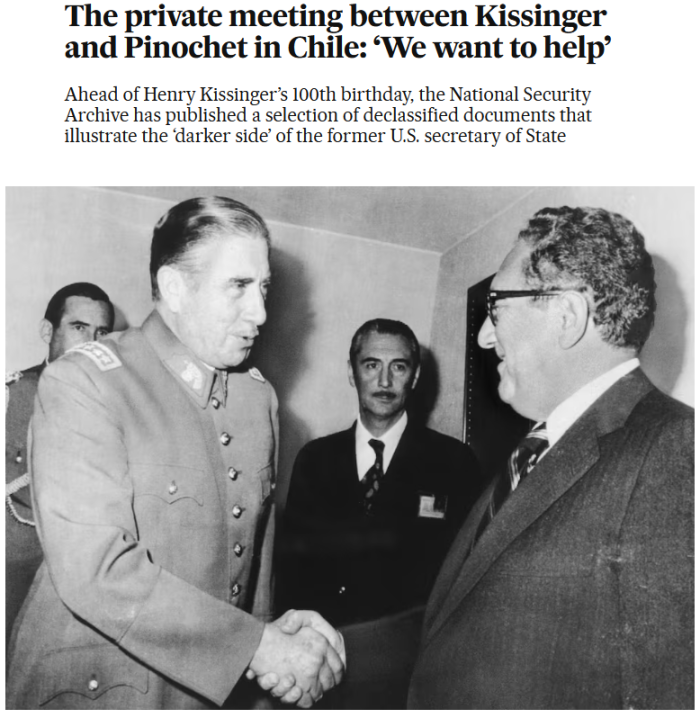
El País (5/26/23)
And so Orlando Letelier, one of the two people who was assassinated here in Washington, was President Allende’s ambassador to the United States. And then he also became his defense minister, and he was defense minister at the time of the coup in Chile in September 1973 that the US government had helped create the conditions for, through a combination of economic and psychological and political warfare for several years.
And so there was a key meeting between Henry Kissinger and Augusto Pinochet, the Chilean dictatorship, in June of 1976, where we know from declassified documents that Kissinger told Pinochet that the US was supportive of what he was doing and that he’d done a great service for the West, even though the dictatorship had been murdering and torturing tens of thousands of people.
And so Pinochet took this as a green light. The big global superpower in the United States seemed to be fine with whatever he wanted to do. And so it was just a few months later then that they carried out this really incredible act of international terrorism, less than two miles from the White House.
JJ: And it’s taken a lot of work to expose the fact of Pinochet’s ordering of that attack, but that fact is no longer in real dispute, right?
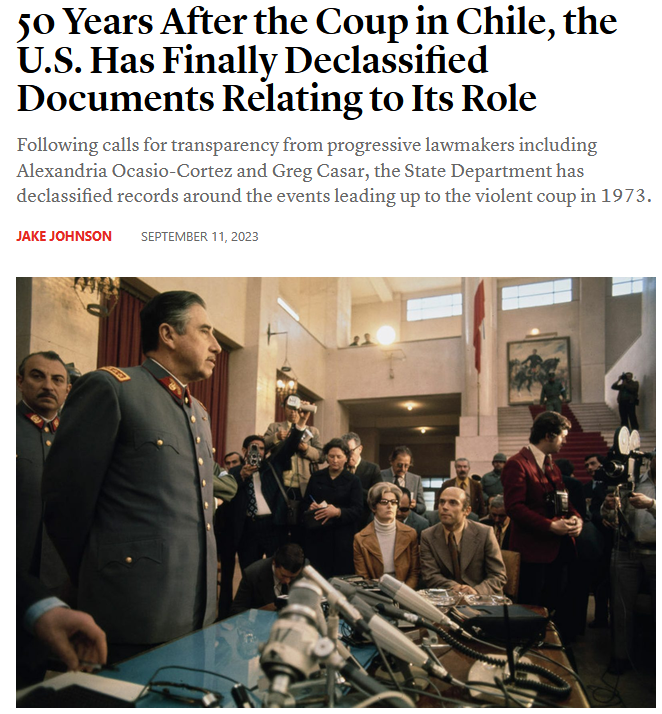
In These Times (9/11/23)
SA: That’s correct. The Clinton administration did provide an important service in declassifying 24,000 documents related to this history from US government files; that has been helpful for journalists, and also helpful for people who’ve brought various legal suits to try to get accountability for their lost loved ones during the dictatorship. But there have been many dogged investigative journalists and others who’ve gone after this question, and it’s widely assumed now that nothing like this would have happened without Pinochet’s direct approval.
JJ: And though he left office in 1990, he was then still head of the armed forces. And just to put a point in it, he was never indicted. Pinochet was never indicted for this particular crime, right?
SA: No. So the big bombshell related to Pinochet came in 1998, when he was in London and was arrested on an order from a Spanish judge. And this just shook things up so much. It struck fear in the hearts of dictators around the world. Even Henry Kissinger reportedly canceled a trip to Brazil because he was afraid of being Pinocheted. That was the verb that came up.
He was held in house arrest in London for about a year, and then they let him go for medical reasons. And during that period, while he was under house arrest, we and many others tried very hard to get the US government to indict him for the Letelier/Moffitt case. Apparently the Clinton administration prepared an indictment, but never acted on it.
So Pinochet got to go back to Chile, but the whole global spotlight had really shaken things up there too. And so they stripped him of his immunity. And at the time of his death in 2005, there were hundreds of cases that he was facing.
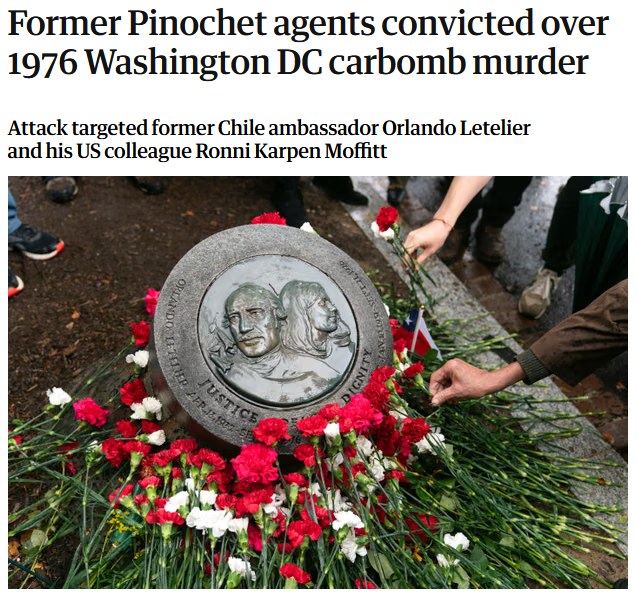
Guardian (6/23/26)
JJ: I’m going to bring you back to news media in just a second, but I did want to say it seems that it’s taken another level of work to get accountability for Ronni Moffitt’s murder in particular, but there has been meaningful movement there too, right?
SA: Yeah, pretty astoundingly. There was a breakthrough on that front just a few months ago, in June of this year. A Chilean judge convicted three former Chilean military officers for their roles in her murder. For some reason, her death had not been included when they had prosecuted various military officials for Orlando Letelier’s death.
And so it’s very late. It took 50 years. That’s twice as long as she was alive. She was a 25-year-old American woman, but it’s still a step forward in terms of progress.
And I think it just goes to show that even over this half century, the pursuit of justice and the memory of these two people who lost their lives, right here in the United States, it just hasn’t waned. And people just keep pursuing it. And I think they’ve proved that persistence really pays off.
JJ: Absolutely. Well, Karen DeYoung at the Washington Post has been following the story for decades. In her piece from just two weeks ago, she said that several officials involved in the case at DoJ and FBI under Clinton and Bush “declined to comment.”
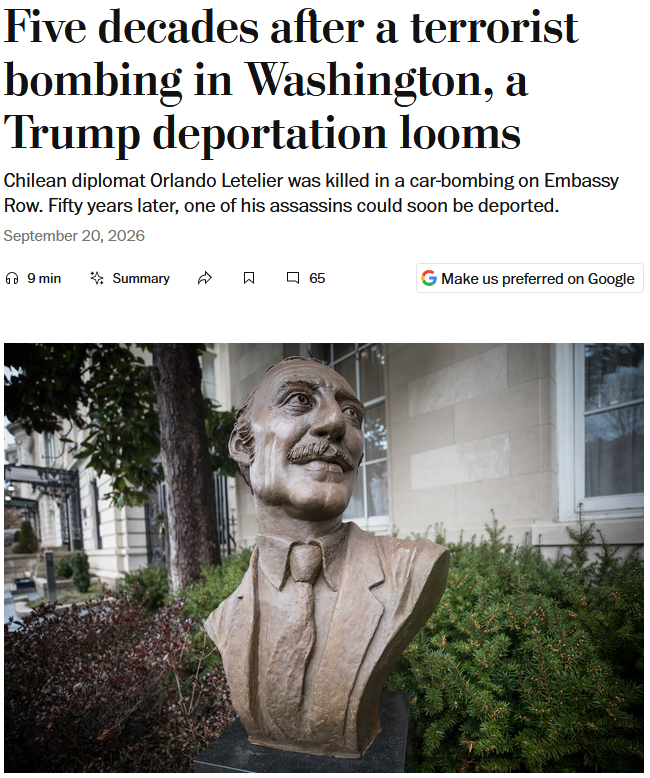
Washington Post (9/20/26)
So I know that other folks have been pushing for it, but it’s taken a lot of pushing on this story, and journalism has something to do with why it hasn’t entered the collective memory in the same way, for example, as other events, but also journalism and information has been the thing that’s been pushing it forward, yeah?
SA: Yeah. I think it’s a mixed record. I mean, I want to go back to the political scenario back in 1976. I mentioned that the Nixon administration had a whole covert CIA operation to create the conditions for a coup. And a big part of that, and I think the part of it that they think was probably most effective, was the propaganda campaign that they funded. They put a couple million dollars into this newspaper, El Mercurio, which was a kind of floundering right-wing rag, and turned it into a very powerful propaganda arm for the dictatorship. And that was very effective, I think, in helping to create the conditions that led to the military coup.
In the United States, there’s been some real journalistic champions over the years. There was a columnist for the Post named Jack Anderson who broke a lot of this story way back in the ’70s, exposing Nixon’s role in the covert operation.
John Dinges, a reporter for the Washington Post, has dedicated decades of his life to, first, working with one of my colleagues, Saul Landau, on a book called Assassination on Embassy Row that also exposed a lot of the story. And then, more recently, he’s written books about Operation Condor, which was the alliance between the Chilean dictatorship and dictatorships in other South American countries to assassinate their opponents around the world. And the Letelier/Moffitt assassination was just one of those.
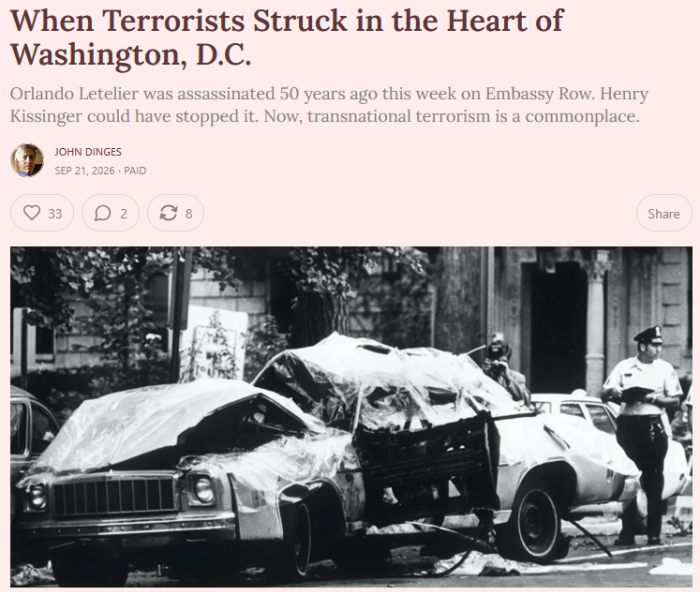
SpyTalk (9/21/26)
So it’s been a mixed story. There’ve been some real champions in the media who’ve kept this story alive. We really appreciate Karen DeYoung as well, but it’s also a story of how the media can be exploited for all the wrong reasons.
JJ: And it’s a story also about collective memory. There’s a reason that some of us always say “September 11, 2001,” because—
SA: This is the other 9/11.
JJ: September 11, 1973, is a deeply meaningful date for people. There’s not just one September 11. And I just kind of feel if journalists had not just covered it at the time, but invoked it when it was meaningful to invoke it, we would have a better understanding.
SA: Yeah. And the role of the media in glorifying Kissinger and his legacy—you can imagine the groans that erupt around my organization, the Institute for Policy Studies, whenever he would get a prominent op-ed in leading media on this, that or the other topic over the years. And he’s someone who should have been completely discredited, if not prosecuted for the crimes that he was involved in.
And there’s really a strong argument, and John Dinges made this in an article last week, that he could have prevented this assassination in downtown Washington, DC. He had the opening in a meeting with Pinochet. He knew that they were starting to carry out these kinds of actions around the world. He could have put a stop to that, and he didn’t. He was still seeing Pinochet as an ally in the Cold War.
JJ: Yeah. And that idea of allyship, meaning that the US doesn’t seek international justice, that’s a 2026 issue. That’s not something that is consigned to the past. If we integrated the understanding of what happened, it would have meaning for our understanding of what’s happening today, right?
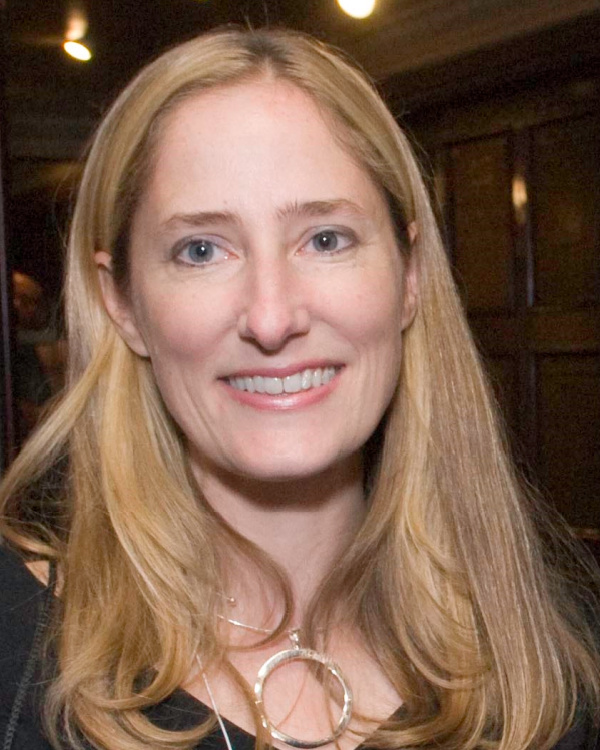
Sarah Anderson: “Unfortunately our history is always going to be a few steps forward and a couple steps back, and people just need to keep pushing through that.”
SA: Absolutely. As I look back on this history, one thing that’s clear is that progress on human rights is not linear. You think you’ve gotten to a place where there are some norms and all, and you’ve got institutions that have been built up to try to defend human rights. And then you’ve got a moment like today, when the current administration is busily trying to dismantle that system, withdrawing from the UN Human Rights Council, gutting the annual human rights reports that the State Department is supposed to do, bombing these boats in Venezuela, all of the charges around human rights abuses in the immigrant detention centers.
And unfortunately our history is always going to be a few steps forward and a couple steps back, and people just need to keep pushing through that. And I just commend all of the diverse forces around this case: the family members, the lawyers, the journalists, the human rights activists, the artists who’ve helped inspire people to continue to build momentum around this. That is really a key lesson, I think, from the history around the Letelier/Moffitt case, that it takes very diverse forces to keep these movements going through thick and thin. And we’re in a dark moment now that we’re going to get through.
JJ: And you may have just answered it, but I was just going to say finally that I saw a quote from you from 2023, speaking at Sheridan Circle, saying:
We’re gathered here because the military dictatorship that took power 50 years ago tried to put its bloody mark on this spot, but we’ve taken it back. We’ve turned this site of the assassination of Orlando Letelier and Ronni Karpen Moffitt into our place, our place for remembering our fallen heroes, a place for renewing our commitment to justice and democracy, and a place of hope.
That’s you speaking a few years ago, and I want to just say, where are you seeing that hope? I think you’ve addressed it, but what would you have folks think about? And just I’ll tack onto that: IPS has been doing Letelier/Moffitt Human Rights Awards for years now, and that’s part of connecting this lamentable past to a more hopeful future.
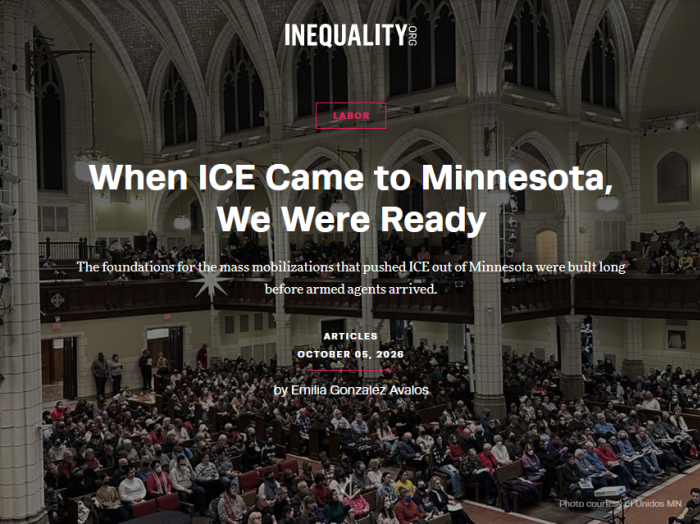
Inequality.org (10/5/26)
SA: Absolutely. And one of our awardees this year I am so excited about, because it’s Unidos Minnesota, one of the leading groups in the Minneapolis area that has been the backbone of the resistance to the ICE surge there. And one of the things they’ve done is conduct constitutional observer trainings, so that anyone could go and learn what you can do if you are seeing an act of injustice, how you can document that, how you can use that information to build accountability.
Hundreds of thousands of people by now—in Minnesota, but across the country—have engaged in that kind of training. And I see that as one bright hope.
Everybody today has a camera in their pocket. We can use them to document things more easily, in a way that they couldn’t back in 1976. And it’s going to be so critical for our long-term history to be documenting what is happening in this country. Media can’t be everywhere, but we can try to document this, so that the people who are harmed in the current moment are never forgotten, and that what is happening to them is documented, and we can build stronger systems to protect people for the future.
JJ: All right. We’ll end on that note.
We’ve been speaking with Sarah Anderson. She directs the Global Economy Project at the Institute for Policy Studies. You can find their many, many years of work online at IPS-DC.org.
We’re also referring folks to National Security Archive. They’re housed at George Washington University. They’re online at NSArchive.GWU.edu. Sarah Anderson, thank you so very much for joining us this week on CounterSpin.
SA: My pleasure. Thank you.
Originally reported by FAIR by Janine Jackson. Read the full story at the source.
Comments
No comments yet. Be the first to share your thoughts.
Leave a Comment