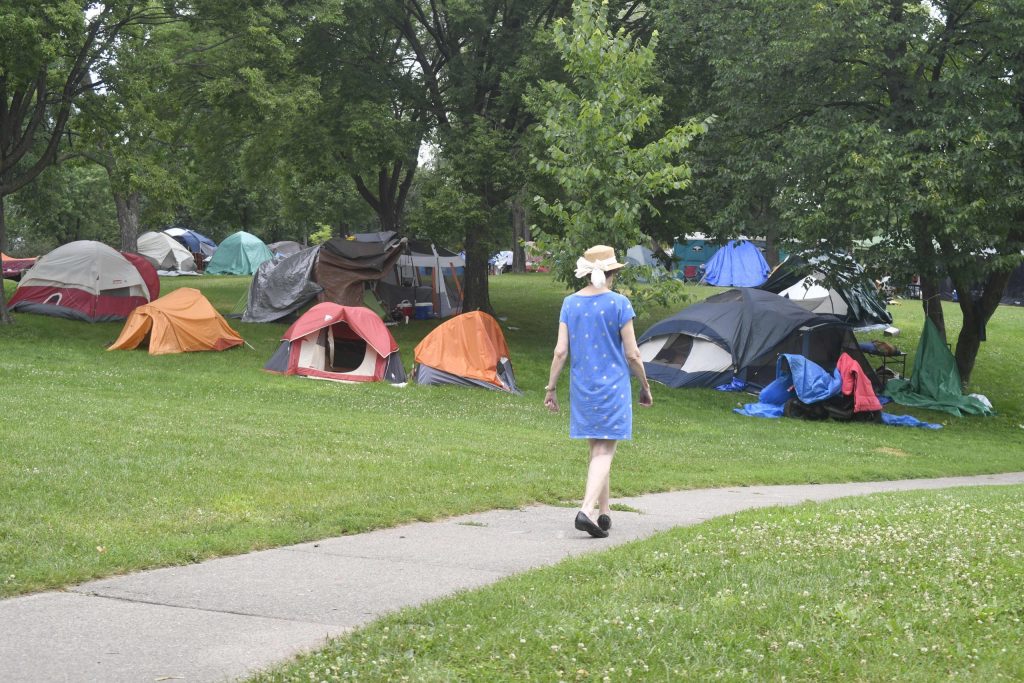

A Minneapolis property owner was fined $7,000 in August after a city inspection of an East Lake Street encampment turned up drug paraphernalia and human waste. It is one small data point in a much larger pattern: Informal homeless encampments across the city routinely lack toilets, clean water, or handwashing stations — conditions the Minnesota Department of Health has explicitly flagged as a communicable disease risk, for residents and surrounding neighborhoods alike.
Related: Whenever you hear about an encampment ‘sweep,’ first ask: Where will the people go?
The good news is that Minneapolis’s broader response to homelessness is actually improving. The city’s own data shows real progress. Closure-related costs dropped 81%, from roughly $330,000 in the second half of 2024 to $63,000 in the following quarter, while the number of homeless people accepting shelter jumped from nine to 53. That is a meaningful shift from a purely reactive, police-heavy approach toward something that actually connects people to services.
What is still missing is sanitation infrastructure built for the reality of encampments while they exist, not just faster closures once they do.
What other cities have proven
San Francisco’s Pit Stop Program deploys staffed public toilets, handwashing stations and needle disposal directly into high-need areas, reducing open defecation and building trust between outreach workers and the people they serve. Minneapolis does not need to invent this model. It needs to fund it, contracting with local nonprofits for staffing and maintenance, and amending city code to permit temporary sanitation infrastructure on public land.
Minneapolis already has proof that direct, person-centered outreach works. Hennepin County’s Streets to Housing program served 839 people in 2023 and moved 51% of them into permanent housing or shelter, a strong outcome by any national comparison. Pairing that kind of outreach to the homeless with on-site sanitation, rather than treating them as separate problems, is not a leap: It is a matter of coordinating what the city already funds.
The clearest local proof of concept is Avivo Village, the low-barrier indoor shelter in the North Loop. As of this year, it has served more than 850 people, moved 347 into permanent housing and reversed 258 overdoses, combining housing with onsite mental health care and substance use treatment. It is not without real tensions: Police have responded to the site hundreds of times since it opened, and at least one former resident has publicly described feeling unsafe there. That is worth taking seriously, not waving away. But the alternative most of those residents came from was the street, and the numbers on housing placement and overdose reversal are real.
The missing piece
None of this requires Minneapolis to choose between enforcement and compassion. It requires treating sanitation as core infrastructure rather than an afterthought addressed only after conditions become dangerous enough to trigger a closure and a fine. Managed encampment zones, sanctioned outdoor spaces with toilets, security and on-site case management have worked in Portland and Seattle specifically because they pair basic dignity with a path toward housing rather than simply displacing the problem to the next block.
Minneapolis has the outreach infrastructure, the housing model, and, now, data showing that investment in real solutions outperforms enforcement alone. What it has not yet done is fund the unglamorous basics, toilets, handwashing stations, showers, that would make every other part of this strategy safer while it is working. That is a solvable problem, and a comparatively cheap one next to what the city is already spending on closures.
Amy Boelter is a Ph.D. candidate in global health equity at Meharry Medical College, School of Global Health, and lives in Brooklyn Park.
The post Minneapolis is making progress on homeless encampments, but sanitation remains an afterthought appeared first on MinnPost.
Originally reported by MinnPost by By Amy Boelter. Read the full story at the source.
Comments
No comments yet. Be the first to share your thoughts.
Leave a Comment