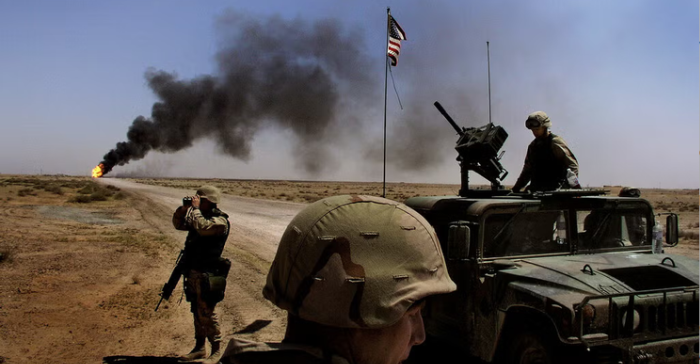
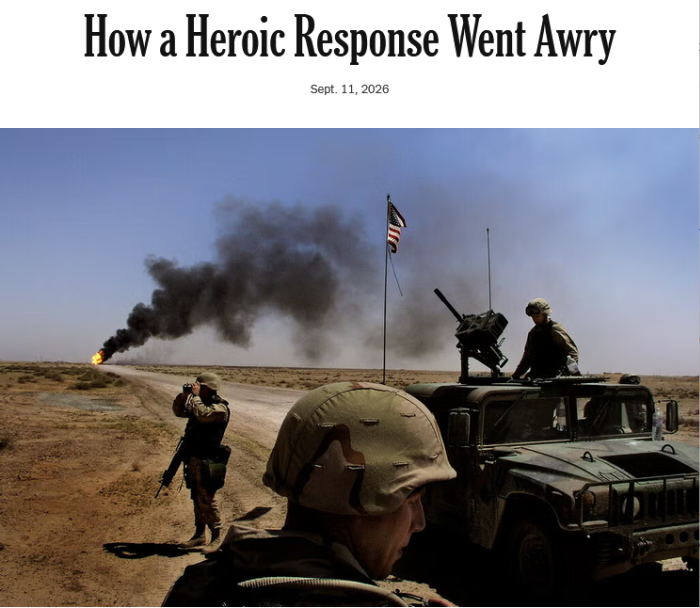
As an example of how the “country’s initial response” to 9/11 was “inspired and unifying,” the New York Times (9/11/26) notes that “within weeks” the US “went to war against the attacks’ plotters and their protectors in Afghanistan.”
The 25th anniversary of September 11, 2001, occasioned retrospectives on both the attacks carried out against the US that day and on the wars that the US prosecuted in their aftermath.Ft In its editorial remembrance, the New York Times (9/11/26)—which played a critical role in dampening skepticism of the “Global War on Terror”—rationalized the cataclysmic violence the US unleashed after 9/11, and assigned greater value to American lives over those of other people.
Under the headline “How a Heroic Response Went Awry,” the editorial board asserted:
The war against the Taliban and the Qaeda forces there was a justified and necessary response to the attacks. Within months, the US military destroyed Al Qaeda’s camps (even if killing Osama bin Laden would take nearly a decade) and drove the Taliban from power.
To say that a policy is “necessary” is to say that there is no alternative. But there was an alternative—namely, reaching an agreement with the Taliban for bin Laden to be extradited from Afghanistan, a possibility that existed before and immediately after 9/11.
The US, however, did not pursue this option as seriously as it could have. As the Washington Post reported on October 29, 2001:
Over three years and on as many continents, US officials met in public and secret at least 20 times with Taliban representatives to discuss ways the regime could bring suspected terrorist Osama bin Laden to justice.
Talks continued until just days before the September 11 attacks, and Taliban representatives repeatedly suggested they would hand over bin Laden if their conditions were met, sources close to the discussions said.
Throughout the years, however, State Department officials refused to soften their demand that bin Laden face trial in the US justice system.
A CIA administrator was quoted in the report: “I have no doubts [the Taliban] wanted to get rid of [bin Laden]. He was a pain in the neck.”
In addition, a former head of Saudi intelligence said that, in 1998, the Taliban agreed to hand over bin Laden to Saudi Arabia, a close US ally; the source said that the Taliban changed course after the US fired cruise missiles at an apparent bin Laden camp in Afghanistan and a pharmaceutical factory in Sudan, following attacks on US embassies in Kenya and Tanzania attributed to Al Qaeda (LA Times, 11/4/01).
Then, just a week after the US invaded Afghanistan, the Taliban offered to discuss handing over bin Laden if the US stopped bombing Afghanistan and provided evidence that bin Laden was involved in 9/11 (Guardian, 10/14/01).
In other words, far from being “necessary,” the Afghan War was a choice the US made when diplomacy appeared to be a viable option. And we now know that those 20 years of war had disastrous effects on Afghans (Jacobin, 9/11/21; Al Jazeera, 9/11/21), and resulted in the Taliban returning to power.
‘An effective battle plan’
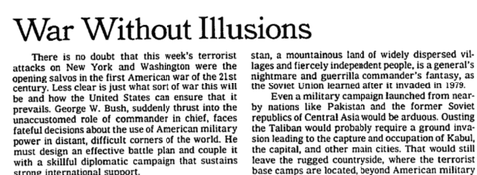
Though it called for a “War Without Illusions,” the New York Times (9/15/01) would play a leading role in providing the illusions the Bush administration needed for the wars it wanted to fight.
This preference for war—expressed as a pretense that the US had no other choice—is consistent with the New York Times’ approach in the immediate aftermath of 9/11. While the paper’s editorial (9/12/01) the day after the attacks reminded readers that “the civilians who live in the same places that terrorists may dwell” have lives that are “just as precious as the ones that we have lost,” the editors quickly dropped this line of thinking.
Three days later (9/15/01), the Times editorial “War Without Illusions” took for granted that the US was going to attack other countries. The editorial opened:
There is no doubt that this week’s terrorist attacks on New York and Washington were the opening salvos in the first American war of the 21st century. Less clear is just what sort of war this will be and how the United States can ensure that it prevails…. [George W. Bush] must design an effective battle plan and couple it with a skillful diplomatic campaign that sustains strong international support.
The article discussed what it called “the one state where American military power might be effectively used”—namely, Afghanistan—and closed by saying that “the nature of the enemy, and the sanctuaries where he hides, promise to make this a long and unpredictable war.”
As one of the country’s leading newspapers, and one based in the city that bore the brunt of the 9/11 attacks, the Times could have been a powerful voice questioning a military response. Instead the paper treated that approach as a fait accompli.
‘Smart in selecting targets’
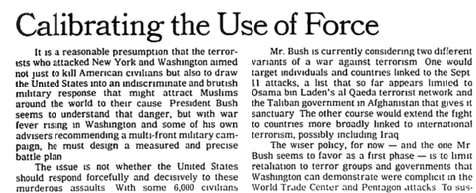
“America has every right to strike back against its assailants, wherever they may be,” the New York Times (9/22/01) asserts—a “right” the Times would not likely grant to nations that have been assaulted by US forces.
An editorial published a week later (9/22/01) again treated war as inevitable, calling on Bush to “design a measured and precise battle plan” and emphasizing that Washington must be “smart in selecting targets and cognizant of the political consequences that its military operations are likely to produce in the Islamic world.” In short, the authors debated how to prosecute the war rather than whether to do so.
That September 22 editorial continued:
Mr. Bush is currently considering two different variants of a war against terrorism. One would target individuals and countries linked to the September 11 attacks, a list that so far appears limited to Osama bin Laden’s al Qaeda terrorist network and the Taliban government in Afghanistan that gives it sanctuary. The other course would extend the fight to countries more broadly linked to international terrorism, possibly including Iraq.
The wiser policy, for now—and the one Mr. Bush seems to favor as a first phase—is to limit retaliation to terror groups and governments that Washington can demonstrate were complicit in the World Trade Center and Pentagon attacks.
Thus the editors endorsed invading Afghanistan immediately, while carefully leaving open the possibility of attacking Iraq and other countries down the road.
‘Justified’—because it’s us
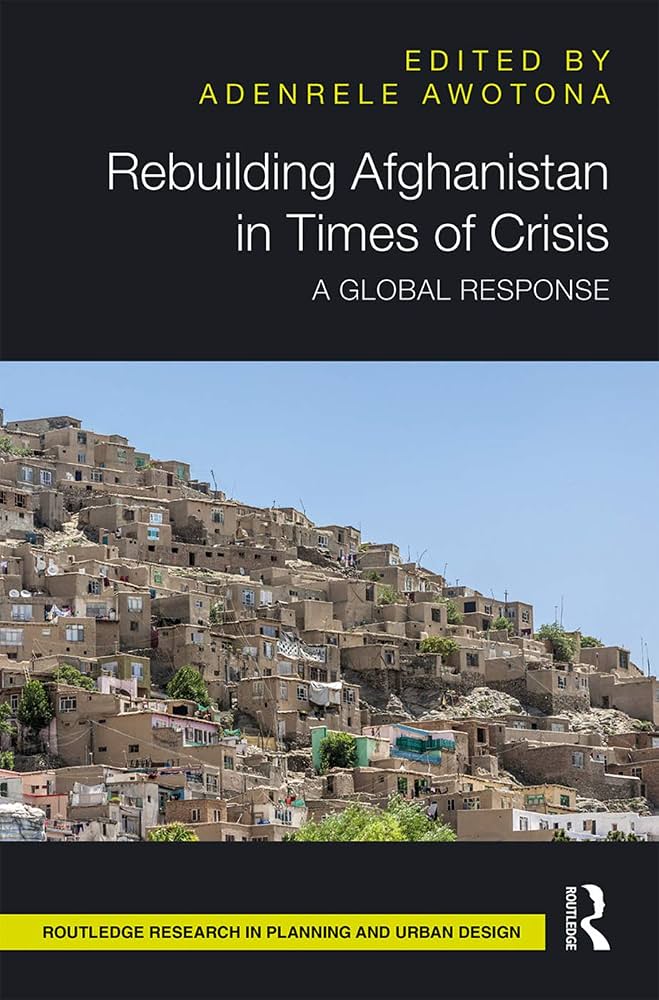
In Rebuilding Afghanistan in Times of Crisis (Routledge, 2019), David N. Gibbs writes, “If Afghanistan is now in a state of chronic disorder, this is a state of affairs that the United States helped to create.”
The claim in the New York Times’ 9/11 retrospective (9/11/26) that invading Afghanistan was “justified” is similarly weak. Invading Afghanistan was illegal under national law, so it wasn’t “justified” in the juridical sense. The Times doesn’t explain its reasoning. But—considering that this was an article about the 25th anniversary of 9/11—we can infer that the authors’ unstated premise is that, because bin Laden was in Afghanistan with the Taliban’s permission, attacking Afghanistan was just. Indeed, earlier in the piece, the authors said that, “Within weeks [of 9/11], the United States . . . went to war against the attacks’ plotters and their protectors in Afghanistan.”
The view that attacking Afghanistan was “justified” rests on the assumption that American lives have greater value than those of Afghans. I cannot find any Times editorials contending that it would be “justified” for, say, Korea, Vietnam, Cuba, Chile, Guatemala, Nicaragua, Iran or Iraq to bomb and occupy the United States following the devastating violence the US wrought in each of these nations.
As David N. Gibbs documented in Rebuilding Afghanistan in Times of Crisis (Routledge, 2019), the historical run-up to 9/11 is crucial here. In the 1970s and 1980s, the US and its Saudi and Pakistani clients armed and trained murderous mujahideen fighters who went to war against progressive elements in Afghanistan, the country’s Communist government and, later, the Soviet forces that intervened to try and keep it in power. In doing so, the US created the conditions for the Taliban and Al Qaeda to get a foothold in Afghanistan.
The US unleashed reactionary violence in Afghanistan that ultimately led to mass killings being perpetrated against the US by a network based partly in Afghanistan, and the Times thinks that somehow “justified” the US invasion of Afghanistan. Such a view takes for granted that terror attacks against the United States are unjust, but that it’s legitimate to kill Afghans before and after. That position only makes sense if one accepts that it’s indefensible to murder Americans, but defensible to do the same to Afghans on a far larger scale.
Accidentally killing millions
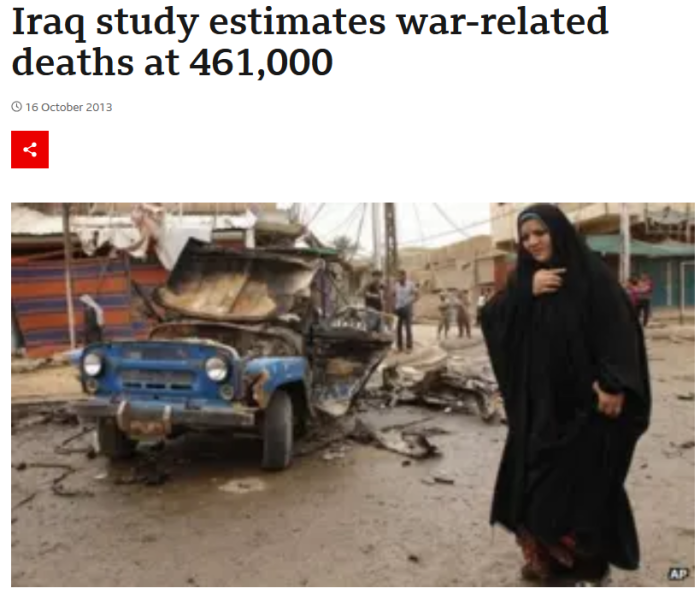
Citing a study by PLOS Medicine (10/15/13), the BBC (10/16/13) reported that “about half a million people died in Iraq as a result of war-related causes between the US-led invasion in 2003 and mid-2011.”
The New York Times editors (9/11/26) went on to describe the invasions, bombings, and occupations the US carried out during the war on terror as “misguided wars” and wrote: “We ask that America face the mistakes that it made.”
The war on terror killed at least 4.5-4.7 million people, primarily in Afghanistan, Pakistan, Iraq, Syria and Yemen. Yet the Times used the exculpatory terms “misguided” and “mistakes” as if all the US were guilty of were a small lapse in judgment without any ill intent.
The editors described what they viewed as the US’s “three big mistakes”: letting “mission creep” turn the Afghanistan war into an effort to transform the country into a democracy; starting “an unnecessary war in Iraq”; and “betray[ing]…American values in the service of defeating terrorism” by torturing people and detaining them without charge.
Occupying Afghanistan for 20 years at a cost of more than 176,000 lives cannot reasonably be brushed aside as an unfortunate blunder. The same goes for the illegal (not just “unnecessary”) invasion of Iraq that fomented sectarian violence (Foreign Policy in Focus, 3/6/06) and caused—depending on which study one finds most persuasive—somewhere between roughly half a million Iraqi deaths in the first eight years after the invasion (BBC, 10/16/13) and 1 million Iraqi casualties in its first five years (Reuters, 1/30/08).
Torturing and detaining people without due process likewise cannot be dismissed as minor oopsies. These policies left widespread physical and psychological scars—or worse, as Brown University’s Costs of War project (1/9/22) noted:
From 2002 to 2005, the peak years of US detention and torture programs, at least 17 people died from abuse while in the custody of the CIA or the US or UK militaries in Afghanistan or Iraq.
These were all conscious policy choices with grave consequences for millions of Arab and Muslim people; states don’t torture, arbitrarily detain and kill millions of people by accident.
Now, according to the Times editorial, President Trump is “repeat[ing] some of the mistakes” of the US’s response to 9/11, “including through a self-defeating war of choice in Iran.”
Casting such decisions as unfortunate mishaps provides cover for the perpetrators and reveals the imperial mindset operating at the Times: No matter how much harm the US inflicts, the paper seems to suggest, it’s simply the result of errors in judgment, and therefore is morally—and legally—exculpable.
Mea innocentia
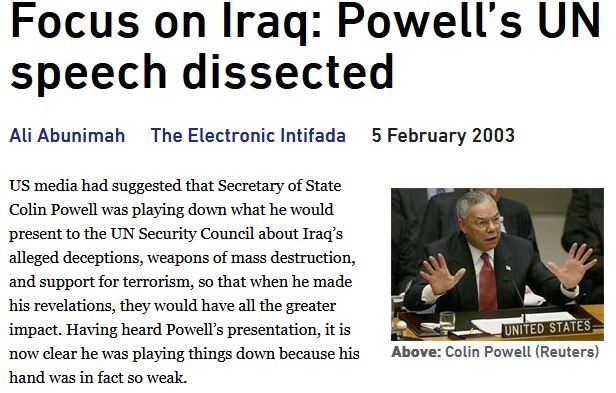
Electronic Intifada (2/5/03) could see the glaring weakness of Colin Powell’s case for Iraqi WMDs; why couldn’t the New York Times editorial board?
Notably absent in the New York Times’ look back (9/11/26) at the war on terror—just like three years ago, in its 20th anniversary Iraq retrospective (FAIR.org, 3/22/23)—was any reflection on its own role in selling the wars to the public, particularly in the case of Iraq. The editors remarked that the war on Iraq “was started on false pretenses”—without adding that the paper itself helped to amplify that disinformation.
That Times reporters like Judith Miller and Michael R. Gordon provided a valuable service to the Bush administration’s propaganda campaign is well-documented (FAIR.org, 3/22/23), and even prompted a kind of mea culpa from the paper in 2004. It wasn’t just the news staff, however; the Times editorial page played a similarly discreditable job in the run-up to the Iraq invasion.
For instance, a month and a half before the US invaded Iraq, the Times (2/6/03) ran an editorial praising Secretary of State Colin Powell’s now infamous presentation at the UN of the “evidence” that Iraq had weapons of mass destruction. The article said that Powell had articulated
the most powerful case to date that Saddam Hussein stands in defiance of Security Council resolutions and has no intention of revealing or surrendering whatever unconventional weapons he may have. In doing so, with the help of spy satellite photos and communications intercepts, Mr. Powell placed squarely before the Security Council the fateful question of how it should respond.
The piece went on to assert that Powell’s presentation “may not have produced a ‘’smoking gun,’ but it left little question that Mr. Hussein had tried hard to conceal one.” In other words, the paper uncritically accepted Powell’s claims that Iraq had an illicit weapons program requiring the Security Council to “respond.” It’s not as if it was impossible to produce a skeptical response in real time. While one of the US’s most well-resourced newspapers failed to do so, Ali Abunimah debunked Powell’s performance in the independent outlet the Electronic Intifada (2/5/03). (See also FAIR.org, 2/10/03.)
The Times subsequently published an editorial (2/15/03) headlined “Disarming Iraq.” The editors said that it was up to the UN Security Council “to decide whether Iraq is disarming. In our judgment, Iraq is not.” It closed by claiming:
There is ample evidence that Iraq has produced highly toxic VX nerve gas and anthrax and has the capacity to produce a lot more. It has concealed these materials, lied about them, and more recently failed to account for them to the current inspectors. The Security Council doesn’t need to sit through more months of inconclusive reports. It needs full and immediate Iraqi disarmament. It needs to say so, backed by the threat of military force.
Clearly, the paper was perpetuating the unfounded claim that there was good reason to believe Iraq had such weapons, and that it was an imminent threat urgently in need of disarming.
By hyping such bogus claims, the Times contributed to creating a climate for the aggression against Iraq, thereby helping to unleash a war in which the US-led coalition killed thousands of Iraqi children (Guardian, 1/3/12). However, the Times’ review of the war on terror acquitted itself of wrongdoing.
What the Times‘ 9/11 retrospective showed is that, far from wanting to help create a more peaceful and just world, its priority is to burnish the image of the US state and its military as forces that sometimes cause harm, but only inadvertently, and to tell their audiences that American lives matter more than those in nations whose populations are mostly poor and brown.
Originally reported by FAIR by Gregory Shupak. Read the full story at the source.
Comments
No comments yet. Be the first to share your thoughts.
Leave a Comment